The London of Sherlock Holmes
Being a Sherlock Holmes fan is unlike belonging to any other fandom. Because Holmes didn’t just exist in stories. He, to this day, exists in this city, on streets that are still here, in buildings that are still standing, in a London that you can still, if you look at it right, almost see.
The BBC adaptation brought an entirely new generation into this — and fair enough, because it’s brilliant — and the Guy Ritchie films before that kicked the whole thing into a new gear. But the bones of all of it go back to Conan Doyle, to the 1880s, to a London that was gaslit and foggy and absolutely teeming with crime. What’s extraordinary is how much of that London is still there.
This is a location guide organised by where things actually are, with all three versions of Holmes woven in as you go — because in this city, they overlap more than you’d think.
Start at the Source: Baker Street
Get off at Baker Street tube station — the one with the tiled silhouettes of Holmes on the platform walls, which sets the tone immediately — and before you do anything else, find the bronze statue just outside. That profile: the deerstalker, the pipe, the slightly imperious expression. It’s one of the most recognisable silhouettes in the world, and it belongs to a man who never existed. London does this with complete confidence.
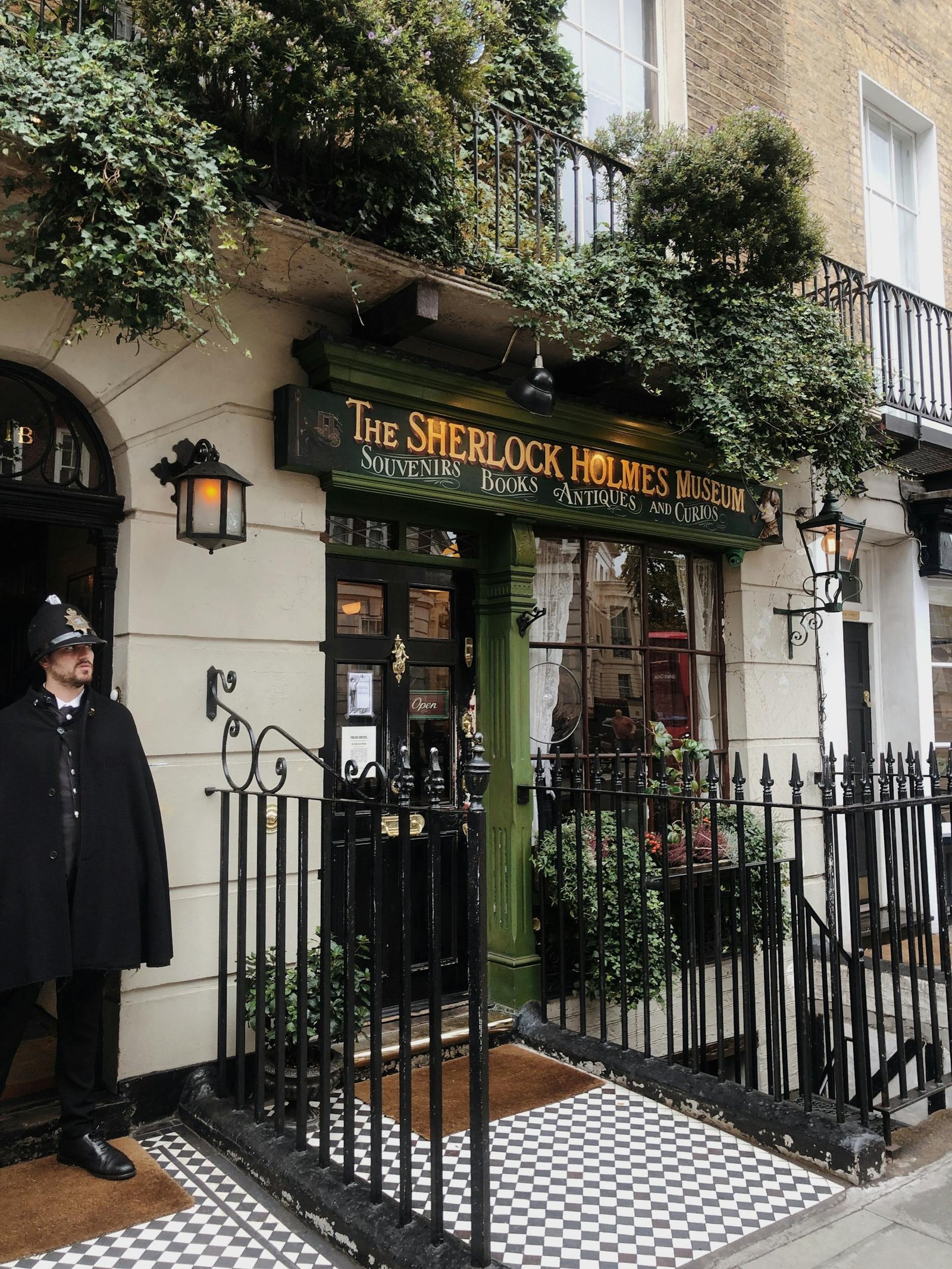
The Sherlock Holmes Museum at 221b Baker Street is a Victorian house fitted out exactly as the stories describe — the sitting room with the chemistry equipment and the violin, the Persian slipper on the mantelpiece, the letters from grateful clients. It’s immersive in a way that museum recreations often aren’t, possibly because Conan Doyle described the rooms in such specific detail that there’s very little interpretive guesswork involved. The gift shop has the largest collection of Holmes memorabilia in the world, which is either wonderful or dangerous depending on your self-control.
Now here’s the thing the museum doesn’t advertise: the actual filming location for 221b Baker Street in the BBC series is not Baker Street at all. It’s 187 North Gower Street in Camden, near UCL, where Speedy’s Café still operates with its original awning entirely intact. The production used a quieter street for practical filming reasons, and Speedy’s became, entirely by accident, one of the most visited filming locations in London. It’s a real working sandwich bar. You can get breakfast there. The Speedy’s awning is still up. Go and look at it.
The Origin Story: Wimpole Street and a Failed Medical Career
A ten-minute walk from Baker Street brings you to 2 Upper Wimpole Street, where there’s a green plaque marking the spot where Conan Doyle worked and wrote in 1891. The backstory behind this plaque is one of my favourite things about literary London: Conan Doyle came to this address to set up a medical practice. Not a single patient ever walked through the door. With time unexpectedly on his hands, he made the decision — right here, in this building — that he could not both run a medical practice and be a writer, and that he was going to choose writing.
The stories of Sherlock Holmes had been appearing in The Strand Magazine to enormous success. He chose correctly. The plaque is quiet about all of this but you can stand in front of it and appreciate what that moment of decision produced.
While you’re in the area: there’s a separate plaque nearby marking the restaurant where Conan Doyle and Oscar Wilde had dinner with the publisher of Lippincott’s Magazine in 1889. That dinner directly resulted in The Sign of Four and The Picture of Dorian Gray both being commissioned on the same evening. Two of the most famous works in English literature, from one dinner. London, honestly.
Smithfield: The Hospital That Appears in Everything
St Bartholomew’s Hospital in Smithfield is one of the oldest hospitals in the world, founded in 1123, and it has been part of the Sherlock Holmes story since the very beginning. In A Study in Scarlet — the first Holmes story, published in 1887 — it’s where Watson and Holmes meet for the first time. Watson was a medical student there. The connection goes back to the source material.
Then the BBC series used it as the location for the Reichenbach Fall — the end of Series 2, where Sherlock apparently jumps from the roof while Watson watches from the pavement below. If you’ve seen it, you know. If you haven’t seen it, what are you doing reading a Sherlock Holmes location guide. The exterior of Barts is recognisable from that scene. Standing there and looking up at the roofline is a particular experience if you watched that episode in real time and did not handle it well. I’m not going to say more than that.
The Priory Church of St Bartholomew the Great is right next door — one of London’s oldest surviving churches, Norman in origin — and this is where the Guy Ritchie film used for the crypt scene where Holmes apprehends Lord Blackwood mid-human-sacrifice. The church has appeared in more films than almost any other building in London (Four Weddings and a Funeral, Shakespeare in Love, Robin Hood: Prince of Thieves), and it earns it every time. Go in if you can. It’s extraordinary.
From Barts, the Old Bailey — the Central Criminal Court — is a two-minute walk across the road. This is where Moriarty’s trial takes place in Series 2 of the BBC show, the episode where he’s acquitted and chaos ensues. The building itself is Grade II listed, topped by the famous golden statue of Justice. You can’t go inside as a casual visitor, but you can stand outside and feel, quite correctly, that this is exactly where a criminal mastermind’s trial should have taken place.
The Strand and Towards Charing Cross
Walk down from Smithfield and you hit The Strand, which still feels, more than almost anywhere else in central London, like a very old street. The Royal Courts of Justice at one end, the whole stretch running down towards Charing Cross — it’s the kind of road that doesn’t need dressing for period filming because it hasn’t changed enough to need it. Holmes walked this street. It’s not a metaphor. He actually walked this street, in the stories.
On Northumberland Street, just off the Strand near Charing Cross station, is the Sherlock Holmes pub. It’s covered in Holmes memorabilia and has a recreation of the Baker Street sitting room visible through a glass panel on the upper floor, which is either deeply charming or slightly alarming and possibly both. It’s mentioned in the original stories — Northumberland Street appears in The Hound of the Baskervilles. Worth a drink and a look.
Belgravia, Buckingham Palace, and the Iceman Cometh
For the BBC series, a significant amount of action takes place in Belgravia — this is Irene Adler’s territory, the setting of A Scandal in Belgravia (based on Conan Doyle’s A Scandal in Bohemia). The streets here look exactly as they should for a woman of Irene Adler’s particular occupational position. Walk around and you’ll feel it. There’s no single specific door to find; the neighbourhood is the point.
Buckingham Palace appears in the BBC series for one of the best cold opens of the entire run — Holmes in a sheet, Buckingham Palace, Mycroft. If you know, you know. The palace is also involved in the original canon in various oblique ways, and the area around St James’s has a general atmosphere of secrets being kept and powerful people preferring not to be noticed, which is very on brand.
The Power Station: A BBC Special
Battersea Power Station — those four iconic chimneys, the building that’s on the cover of Pink Floyd’s Animals, now a very expensive shopping centre — is one of the most visually distinctive locations in the BBC series. The cavernous derelict interior (as it was during filming) is where Sherlock first meets Irene Adler properly in Series 2, and where a key confrontation with Watson takes place. The building was still being redeveloped during filming, which gave the scenes an atmosphere of industrial abandonment that the finished mall version can no longer provide. The exterior remains magnificent. Worth going for the architecture regardless.
The Man Himself: A Final Note
There’s a plaque in London that records the evening Arthur Conan Doyle, Oscar Wilde, and a magazine publisher sat down to dinner and, between them, commissioned two of the most enduring works in the English literary canon. There’s a plaque on Wimpole Street for a man whose medical practice failed and who became one of the most widely read authors in history as a direct result. There’s a hospital that’s been standing since 1123 that still looks the way it did when Conan Doyle wrote Watson’s first scene there.
And there’s a woman — somewhere on the Strand, getting into a taxi, coat collar turned up, moving like she knows exactly where she’s going and why — who may or may not be Irene Adler. You can never entirely rule it out. That’s the thing about this city and this character. The line between the story and the street has always been very thin.
For the full literary London experience — and the bridge I refuse to cross for entirely different fictional reasons — [start here.]
More London fandoms: [Harry Potter’s London →]